TL;DR: This Trainvave Guide is a comprehensive tutorial on ICE First-Timer Checklist: What to Know Before You Board in Germany. Riding a German ICE for the first time? Boarding, coach position (Wagenstand), ticket check, quiet-zone etiquette, and what to eat — the checklist every first-timer needs.
Platform survival: Station navigation, boarding, and rules.
A condensed visual summary of the most important takeaways from our ICE First-Timer Checklist: What to Know Before You Board in Germany guide.
No gates: German stations have no ticket barriers. Validating before boarding is key.
Riding the ICE (Intercity-Express) for the first time is one of the easiest ways to cross Germany — these trains run at up to 300 km/h and link every major city. But a few small things catch first-timers out: the platform is long, the coach you want may be 300 m from where you are standing, and the “quiet zone” is a real rule, not a suggestion. This checklist covers the five things every first-timer asks about: boarding, coach position, the ticket check, etiquette, and food.
Before you arrive: tickets and seats
You do not need a seat reservation to ride the ICE — unlike a flight, an unreserved ticket is still a valid ticket. A reservation simply guarantees you a specific seat. It costs about €5.50 in 2nd class and is included free with 1st-class tickets. For a short off-peak hop you can skip it; for a 3-hour-plus trip or a busy Friday evening, reserve one so you are not standing.
Book through the DB Navigator app or the Deutsche Bahn site, and you can request a window, aisle, table, quiet-zone or family-area seat. These are requests, not guarantees — availability depends on what is left.
1. Boarding: find your platform and coach section
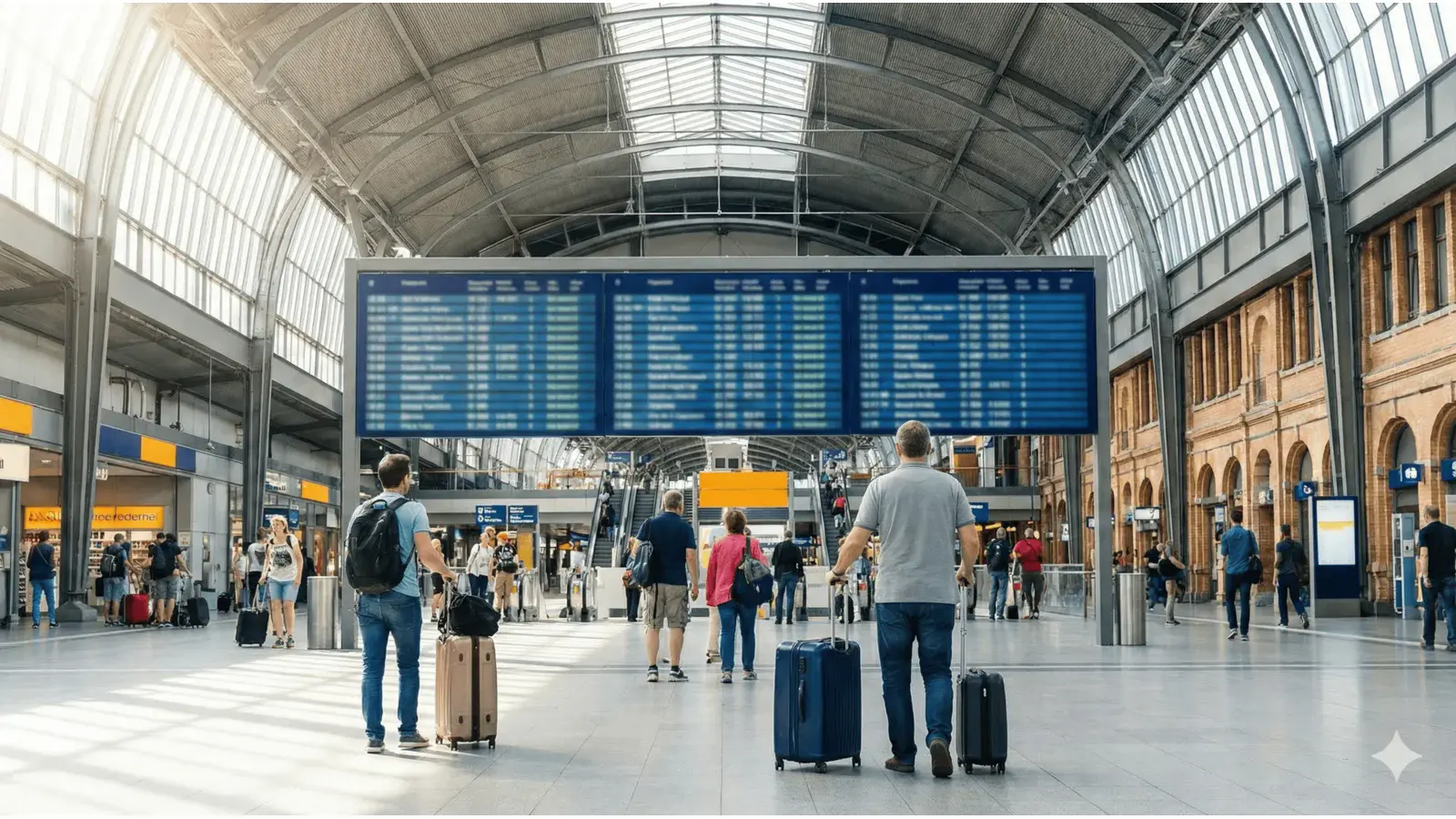
German platforms are divided into lettered sections A, B, C … G running along the length of the platform. Your departure board shows two things that matter:
- Gleis (platform number) — which platform your train leaves from.
- Wagenstand (coach position) — which section your specific coach stops at, e.g. “Wagen 25 in Abschnitt C”.
A long ICE can be 400 m end to end, so the difference between section A and section F is a long walk. The Wagenstandsanzeiger poster next to the board shows the full coach layout for your train. Stand in the correct section and you step straight into your coach; stand at the wrong end and you will be sprinting past other coaches as the doors close.
2. Coach position: board at the right door
When the train arrives, match the coach number on the side of the train to the number on your reservation or the Wagenstand display. ICE doors are grouped in pairs, and the coach you want is not always near the stairwell you came up from. Boarding at the right section is the single biggest first-timer “I wish I’d known that” move.
3. The ticket check (die Kontrolle)
Yes, your ticket will be checked — usually once, partway through the journey, by a conductor walking the train. Have it ready:
- Digital ticket: open it in the DB Navigator app (or your PDF) before the conductor reaches you, and keep your phone charged. A dead phone with no ticket can mean buying a new one.
- Paper ticket: keep it in hand.
- Validation: long-distance ICE/IC tickets bought online are already validated by your name — no stamping. Only some local/regional paper tickets need the red Entwerter machine on the platform.
4. Etiquette: quiet zones, seats, and luggage
ICE carriages are clearly signed, and two zones trip up first-timers:
- Ruhebereich (quiet zone): phones off / no calls, headphones in, voices low. Working and reading only.
- Handybereich (mobile-phone area): fine for calls.
Above each seat, a green light = free, red light = reserved. Sit in a green seat. If you sit in a red one and the reserved passenger shows up, move politely — it happens. Keep luggage in the overhead racks or the end-of-coach storage, never blocking the aisle or the doors.
5. Food, drink, and power
You can absolutely bring your own food and water. Ask the Bordbistro staff for a free refill of tap water. Onboard, the Bordrestaurant / Bordbistro (restaurant car) sells hot meals, coffee, beer and snacks; on some services a snack trolley comes down the aisle. Most seats have at-seat power and USB charging, and there is free Wi-Fi (expect it to dip in tunnels and rural stretches).
Quick first-timer checklist
- Found my Gleis and Wagenstand section on the board
- Standing in the right platform section for my coach
- Ticket open on my phone / in hand, phone charged
- Seat chosen: green light = free, red = reserved
- Picked quiet zone vs phone area on purpose
- Brought a water bottle (free tap-water refills) and snacks
- Know where the Bordbistro / toilet is
How this differs from the other guides
This is the “I’ve never done this” checklist — the practical “what do I actually do at the station and on the train” answer. For deeper dives, see how to validate a ticket, seat reservations explained, 1st vs 2nd class, and ICE vs FlixTrain.
Step-by-Step Instructions
Find your platform (Gleis) and coach section
Check the departure board for your train number, the Gleis (platform), and the Wagenstand — the coach position showing which platform section (A–G) your coach stops at. Stand in that section so you are next to your door when the train arrives.
Board at the right coach, not just any door
ICE trains are long (up to 16 coaches, ~400 m). The displayed Wagenstand tells you whether your coach stops in section A, C or F. Walking the full length inside a busy ICE wastes time; board where your coach actually stops.
Have your ticket ready for the conductor
Keep your digital ticket open on your phone or your paper ticket in hand. The conductor checks tickets on board; ICE tickets are pre-validated by passenger name, so no stamping is needed for long-distance tickets bought online.
Read the seat lights and respect reservations
Above each seat, a green light means free, a red light means reserved. Sit in a green seat, or any seat without a reservation. If someone with a reservation arrives, move politely. Reserve a seat (about €5.50 in 2nd class) for long trips or peak times for peace of mind.
Pick the right zone and mind etiquette
Quiet zones (Ruhebereich) are for working and reading — no phone calls, use headphones. Mobile-phone areas (Handybereich) are for calls. Keep luggage in the racks or by your seat, not blocking aisles, and lower your voice in the quiet zone.
Eat, drink, and charge up
Bring your own food and a water bottle (free tap water from the Bordbistro). The restaurant car sells meals, coffee and snacks; a trolley passes on some services. At-seat power and USB charging are available at most seats, and there is free Wi-Fi (signal varies).
Trademark Notice: Trainvave is an independent information portal and is not affiliated with, endorsed by, or connected to Deutsche Bahn AG, ÖBB, or any other railway company. All brand names, product names, and logos mentioned (including but not limited to ICE, IC, EC, DB, Deutsche Bahn) are trademarks of their respective owners and are used here solely for informational purposes.